

Muʿallim Tawfiq Yusuf المعلم توفيق يوسف المحرقي · cantor of Dayr al-Muharraq, 1917-2005
For seventy years a blind cantor taught the monks of al-Muharraq the hymns, and kept some that no one else had. Tawfiq Yusuf Bishay learned from the monks of his monastery, from a cantor in Sohag and from Mikhail al-Batanuni, taught Ragheb Moftah’s choir for decades, and was, by Moftah’s account in 1975, one of only two cantors who still knew the longest hymn of the Church.12
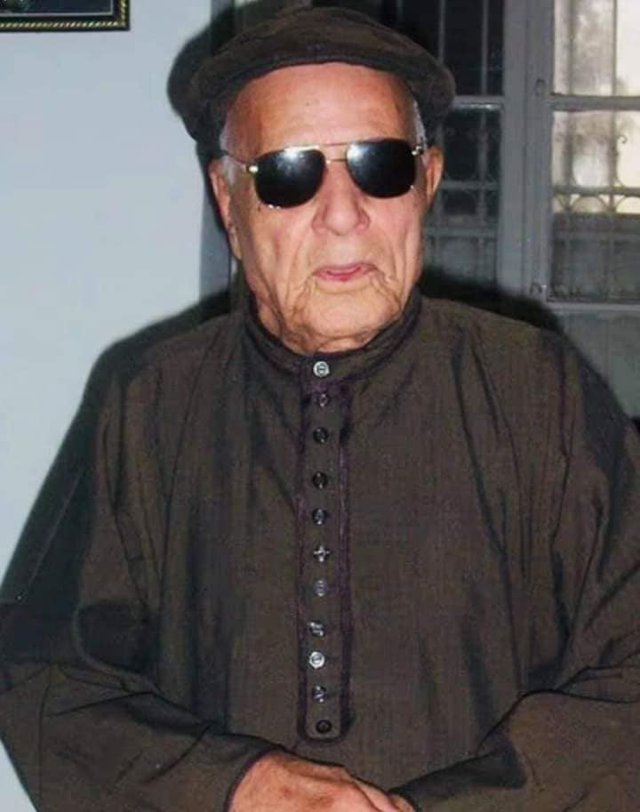
A boy at the monastery
He was born beside the monastery. Tawfiq Yusuf Bishay was born on 12 June 1917 in the estate of the Monastery of the Virgin at al-Muharraq, the youngest of seven brothers. He learned the Psalms in the village kuttab from a cantor named Sulayman before he was eight, and he remembered that it was his mother who encouraged him to go; he also went up to the monastery to learn the hymns.3 He lost his sight at the age of seven.4 At Easter 1925 Bishop Pachomius I, the abbot, made him a reader; he hesitated at first because the boy was so young, until the monks who knew him spoke for him.5
He learned in Sohag and at the monastery. In 1928 he went to Sohag, where a brother of his worked with Bishop Peter I of Sohag and Akhmim, and learned the psalmody and the responses of the liturgy from the cantor Aghabius; “he learned everything he had,” Tawfiq said.6 He came back in January 1931 and asked the abbot, Fr. Tadros Asʿad, to recommend him to a church where he could serve; the abbot answered that the monastery itself needed a cantor to teach the monks, and Tawfiq stayed for the rest of his life.7 At the monastery he learned from the monks, among them “القمص ديمتري، والراهب جورجيوس، والقمص داود” (Fr. Dimitri, the monk Georgios and Fr. Dawud);8 from Fr. Dawud al-Muharraqi he received the expositions sung on the Saturdays and Sundays of Kiahk.9
The pupil of Mikhail al-Batanuni
The monastery brought the great cantor from Cairo. At the end of 1935 the abbot, Fr. Sidarus Saʿd, invited Mikhail al-Batanuni to the monastery.10 Mikhail stayed about a month, was struck by the young cantor’s intelligence, his ear and the strength of his voice, and handed him many hymns;11 he wanted to take Tawfiq back to Cairo, but Tawfiq preferred to stay at the monastery, and the abbot held on to him. Some hymns he could not receive on that visit, among them the great annual Alleluia and the hymns of the Holy Myron.12 Moftah writes that he sent Mikhail to al-Muharraq twice, “with a benefit I still feel.”13 On Mikhail’s last visit, in 1952, Tawfiq received more, among them the great Alleluia, the great تى أوى أن هيكانوس and إيفول هيتين.14
Some hymns survived only through him. Each year he spent a month in Alexandria with Moftah’s choir and went on learning from Mikhail there. The 2005 obituary in al-Kirāza says that he alone received certain hymns from Mikhail, among them the great تى أوى إن هيكانوس, “and but for that they would have vanished at the repose of Muʿallim Mikhail.”15 Moftah, in 1975, named only two cantors who still knew that hymn, which takes fifty minutes to sing: Naṣif ʿAbd al-Masih and Tawfiq Yusuf.16
With Ragheb Moftah
He recorded and taught for the Institute for half a century. In 1950 Moftah asked him to record the Liturgy of St. Gregory, and he spent fifteen days in Cairo doing it. From 1952 to 1998 he spent a month every year with Moftah at al-Mandara in Alexandria, teaching the choir and recording hymns, with Naṣif ʿAbd al-Masih, Ṣadiq ʿAttallah, Fr ʿAbd al-Masih Dawud, Fawzi al-Sharuni and Ibrahim Ayad; in 1955 Moftah gave him the leadership of the choir.17 Moftah called him “the good man, the faithful friend,” and named him among those who studied with Mikhail in Alexandria;18 at Moftah’s funeral Pope Shenouda III remembered him as one of the teachers of the choir, “a teacher who knows the psalmody very well.”19
He taught other monasteries too. Pope Cyril VI sent him each year for three months to the new Monastery of St. Mina at Mariout to teach the monks the psalmody and the hymns, and he was the first to sing the hymn مارو تشاسف in that patriarch’s presence, “for no one had sung it before.”20
The teacher
He taught anyone who asked. He taught at the monastery’s seminary, founded in 1973, and at the Didymus Institute for cantors, founded in 1977, until his repose.21 The Church now trains its cantors at two branches of that institute, one in Shubra in Cairo and one at the monastery.22 When he heard a wrong note he stopped to correct it; he used his cane to beat time, and put his left hand over his left ear to find the pitch, a habit his biographer traces to the singers carved on the walls of Egyptian temples.23 The monastery recorded all the hymns of the Church in his voice, on more than a hundred cassettes. He was ordained a deacon in 1975 and an archdeacon in 1980, and he knew the Bible and theology as well as the hymns.24
His voice was measured once. The 2005 obituary reports that he was tested at Ain Shams University for Nabila ʿIryan’s doctoral thesis on Egyptian church music, and that his voice measured 43.5 decibels, against 26.5 for the next singer tested.25 The report gives no details of the test, and we have not been able to check it.
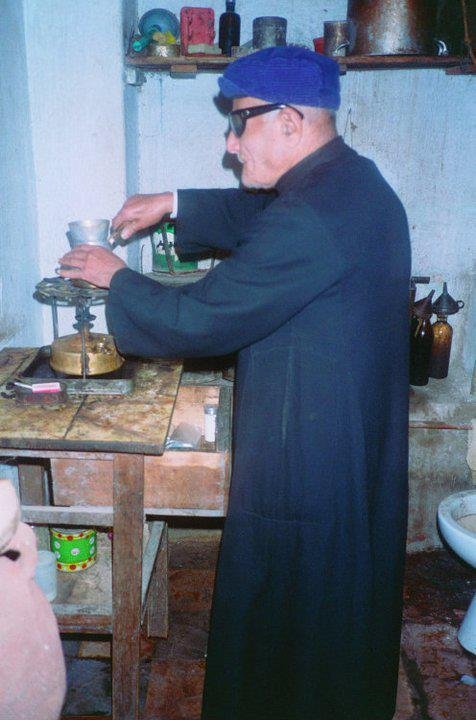
He served the monastery to the end. He lived through six patriarchs, from Cyril V to Shenouda III, and ten abbots of al-Muharraq.26 He kept his room in perfect order and made tea for his visitors himself.27 He reposed on 30 January 2005, the feast of St. Antony, and was buried at the monastery the next day in the presence of five bishops, the monks, the students of the seminary and the Didymus Institute, and many of the priests and cantors he had taught.2829 On this site you can hear his recordings.
Photographs
Notes
- al-Kirāza 2005, “Intiqāl kabīr murattilī al-kanīsa”, pp. 18-19. ↩
- Moftah, al-Kirāza 1975, no. 3, p. 8. ↩
- al-Kirāza 2005, “Intiqāl kabīr murattilī al-kanīsa”, p. 18. ↩
- Badie, al-Kirāza, 22 Feb. 2008, p. 20. ↩
- al-Kirāza 2005, “Intiqāl kabīr murattilī al-kanīsa”, p. 18. ↩
- al-Kirāza 2005, “Intiqāl kabīr murattilī al-kanīsa”, p. 18, tr. ours. ↩
- al-Kirāza 2005, “Intiqāl kabīr murattilī al-kanīsa”, p. 18. ↩
- Karas al-Muḥarraqī, tr. ours. ↩
- Badie, al-Kirāza, 22 Feb. 2008, p. 20. ↩
- al-Kirāza 2005, “Intiqāl kabīr murattilī al-kanīsa”, p. 18. ↩
- Badie, al-Kirāza, 22 Feb. 2008, p. 20. ↩
- al-Kirāza 2005, “Intiqāl kabīr murattilī al-kanīsa”, p. 18. ↩
- Moftah, al-Kirāza 1975, no. 2, p. 5, tr. ours. ↩
- al-Kirāza 2005, “Intiqāl kabīr murattilī al-kanīsa”, p. 18. ↩
- al-Kirāza 2005, “Intiqāl kabīr murattilī al-kanīsa”, p. 18, tr. ours. ↩
- Moftah, al-Kirāza 1975, no. 3, p. 8. ↩
- al-Kirāza 2005, “Intiqāl kabīr murattilī al-kanīsa”, p. 18. ↩
- Moftah, al-Kirāza 1975, no. 2, p. 5, tr. ours. ↩
- Shenouda III, al-Kirāza 2001, p. 10, tr. ours. ↩
- al-Kirāza 2005, “Intiqāl kabīr murattilī al-kanīsa”, p. 19, tr. ours. ↩
- Badie, al-Kirāza, 22 Feb. 2008, p. 20. ↩
- Ragheb 2019, p. 234. ↩
- Badie, al-Kirāza, 22 Feb. 2008, p. 20. ↩
- al-Kirāza 2005, “Intiqāl kabīr murattilī al-kanīsa”, p. 19. ↩
- al-Kirāza 2005, “Intiqāl kabīr murattilī al-kanīsa”, p. 19. ↩
- al-Kirāza 2005, “Intiqāl kabīr murattilī al-kanīsa”, p. 19. ↩
- Badie, al-Kirāza, 22 Feb. 2008, p. 20. ↩
- al-Kirāza 2005, “Intiqāl kabīr murattilī al-kanīsa”, p. 19. ↩
- Badie, al-Kirāza, 22 Feb. 2008, p. 20. ↩
Sources
- “Intiqāl kabīr murattilī al-kanīsa al-muʿallim Tawfīq Yūsuf al-Muḥarraqī,” al-Kirāza 33, nos. 5-6, Cairo, 11 February 2005, pp. 18-19.
«انتقال كبير مرتلي الكنيسة المعلم توفيق يوسف المحرقي»، الكرازة، السنة ٣٣، العددان ٥-٦، ١١ فبراير ٢٠٠٥ - Mina Badie ʿAbd al-Malak, “Min aʿlām murattilī al-kanīsa fī al-qarn al-ʿishrīn alladhīna akmalū al-saʿy,” al-Kirāza 36, nos. 5-6, Cairo, 22 February 2008, p. 20.
مينا بديع عبد الملك، «من أعلام مرتلي الكنيسة في القرن العشرين الذين أكملوا السعي: المرتل توفيق يوسف المحرقي»، الكرازة، السنة ٣٦، العددان ٥-٦، ٢٢ فبراير ٢٠٠٨ - Karas al-Muḥarraqī, “al-Muʿallim Tawfīq,” blog of a monk of Dayr al-Muharraq, 7 December 2018.
الراهب كاراس المحرقي، «إكليريكية الدير المحرق، الفصل الثالث عشر: المعلم توفيق مدرّس الألحان والتسبحة»، ٧ ديسمبر ٢٠١٨ - Ragheb Moftah, “Qiṣṣat tasjīl al-alḥān al-qibṭiyya wa-tārīkh al-muʿallim Mīkhāʾīl,” al-Kirāza 6, Cairo, no. 2, 10 January 1975, pp. 4-5; no. 3, 17 January 1975, pp. 8-9; no. 4, 24 January 1975, p. 5.
راغب مفتاح، «قصة تسجيل الألحان القبطية وتاريخ المعلم ميخائيل»، الكرازة، السنة السادسة، الأعداد ٢ و٣ و٤، يناير ١٩٧٥ - Pope Shenouda III, address at the funeral of Ragheb Moftah, al-Kirāza 29, nos. 21-22, Cairo, 29 June 2001, pp. 9-10.
البابا شنوده الثالث، «كلمة قداسة البابا في جناز الأستاذ راغب مفتاح»، الكرازة، السنة ٢٩، العددان ٢١-٢٢، ٢٩ يونيو ٢٠٠١ - Nicholas Joseph Ragheb, The Transmission of Coptic Orthodox Liturgical Music, PhD dissertation, University of California, Santa Barbara, 2019, p. 234.