

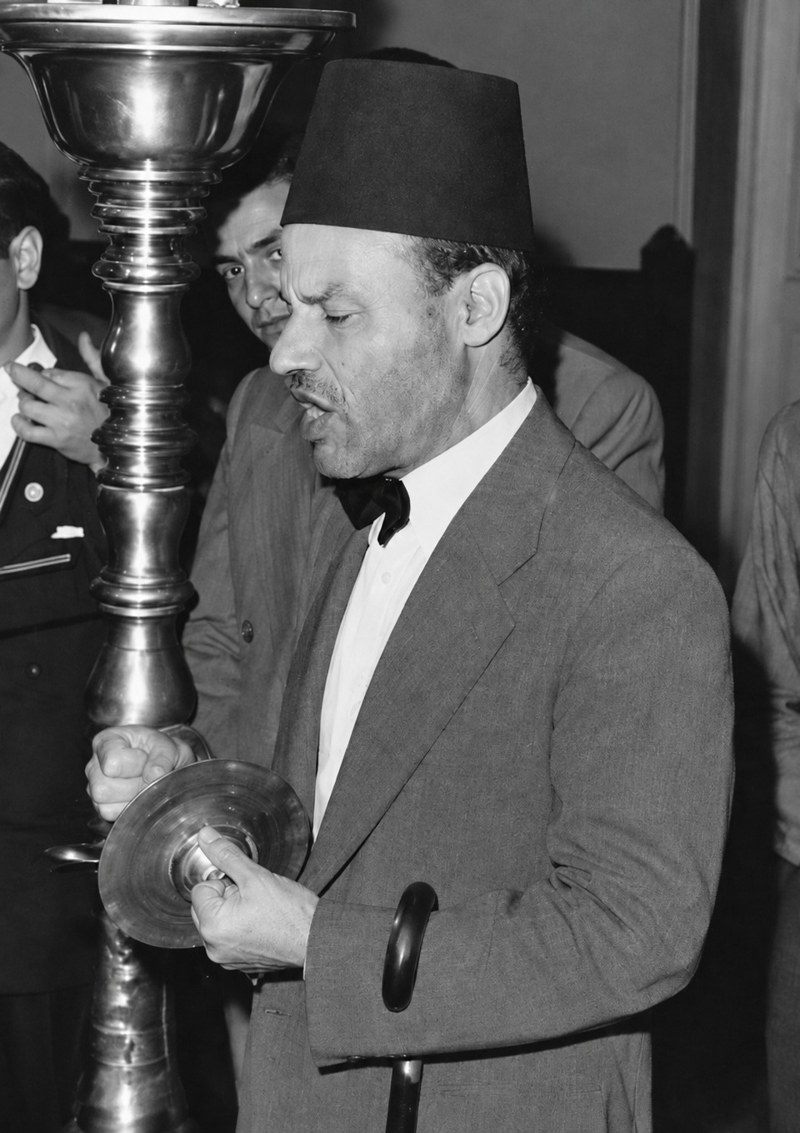
Muʿallim Habib Hanna al-Mirahim المعلم حبيب حنا الميراهم · cantor of the Church of the Virgin at Muharram Bek, Alexandria, 1908-1981
For almost half a century one blind cantor taught the deacons of Alexandria’s second church. Habib Hanna al-Mirahim learned the hymns from Mikhail al-Batanuni and served the Church of the Virgin at Muharram Bek from 1933 until his repose. A site that keeps his recordings names him among those “time has made forgotten” who kept the spirit of the Church, its rites and its hymns.12
Menoufia and the Clerical College
He lost his sight at seven. Habib Hanna al-Mirahim was born on 15 September 1908 at Hissat Malig, near Shibin al-Kom in Menoufia. At seven an eye disease took his sight, but he kept going to the village church, and learned the Psalms, the psalmody and the hymns by heart from its cantor. At twelve he entered the Clerical College, where he mastered the hymns under Mikhail al-Batanuni. From his youth he kept to himself, and as a student, his biographer writes, he lived apart and mixed with no one, to keep himself from stumbling.3
Muharram Bek
He came to Alexandria in 1933. He was appointed cantor of the Church of the Virgin at Muharram Bek, then the second church of Alexandria after St. Mark’s. When the church was consecrated, on the feast of the Virgin, 22 August 1935, he attended the service in the full vestment of a deacon. He served the church for about forty-five years, from its beginnings, and lived unmarried, wholly given to God. The senior priest of the church, Fr. Murqus Basilius, said of him that he was scrupulous about money, content with little, and never sought any gain.4
He made the church’s deacons. His biographer, who was one of them, remembers a Sunday afternoon, 22 August 1958, when a great number of boys had been ordained readers that morning by Bishop Macarius of the Baramus monastery: they all went to the church hall, sat on the floor, and Habib came in, “in his elegant dress,” a suit, a white shirt, a black bow tie and a red tarbush, sat on a chair and sang the hymns while they repeated them after him, for more than an hour and a half. To him, his biographer writes, the deacons of the church owed first of all their mastery of its hymns and its praises.5 Youssef Habib Youssef, who became a writer on the Coptic saints and taught the hymns and Coptic in Alexandria, studied the hymns and the language with him for more than thirty years.6
His voice
He sang as though the hymn were his own prayer. His singing, his biographer writes, was not repetition or duty: he lived in the hymn, with a strong, sweet voice, and pronounced the Coptic and the Arabic soundly. Pope Cyril VI admired him and often came to the church without warning to hear him, and would greet him and shake his hand. One day in 1974 Pope Shenouda III came to the church for the liturgy; Habib stood alone and sang the Hymn of the Virtues, and the patriarch stood at the door of the sanctuary listening.7
His recordings survive. The Coptic Hymns Guide keeps his recordings of the Kiahk hymns and of the Palm Sunday salutations;8 the site of the Church of the Virgin at Muharram Bek keeps more, among them Lenten hymns, the Seven Tunes, and hymns of the Saturday and Sunday psalmody.9
His last years
He came early to church until the end. Illness in his last years kept him from some of the services, but the deacons made sure he was with them for Holy Week, and above all for Good Friday. He fell asleep in the Lord on 22 February 1981, and his funeral was held at the Church of the Virgin at Muharram Bek, which he had served “with all faithfulness and joy.”10
Notes
- Badie, al-Kirāza, 14 Dec. 2007, p. 11. ↩
- tibarthenos.net, Habib Hanna, introduction, tr. ours. ↩
- Badie, al-Kirāza, 14 Dec. 2007, p. 11. ↩
- Badie, al-Kirāza, 14 Dec. 2007, p. 11. ↩
- Badie, al-Kirāza, 14 Dec. 2007, p. 11, tr. ours. ↩
- Badie, al-Kirāza, 18 Jan. 2008, p. 16. ↩
- Badie, al-Kirāza, 14 Dec. 2007, p. 11. ↩
- Hymns Guide, Habib al-Mirahim, recordings. ↩
- tibarthenos.net, Habib Hanna, list of recordings. ↩
- Badie, al-Kirāza, 14 Dec. 2007, p. 11, tr. ours. ↩
Sources
- Mina Badie ʿAbd al-Malak, “Min aʿlām murattilī al-kanīsa fī al-qarn al-ʿishrīn alladhīna akmalū al-saʿy (5): al-Murattil Ḥabīb Ḥannā al-Mīrāhim,” al-Kirāza 35, nos. 41-42, Cairo, 14 December 2007, p. 11.
مينا بديع عبد الملك، «من أعلام مرتلي الكنيسة في القرن العشرين الذين أكملوا السعي (٥): المرتل حبيب حنا الميراهم»، الكرازة، السنة ٣٥، العددان ٤١-٤٢، ١٤ ديسمبر ٢٠٠٧ - Mina Badie ʿAbd al-Malak, “Min aʿlām murattilī al-kanīsa fī al-qarn al-ʿishrīn alladhīna akmalū al-saʿy (6): al-Murattil Yūsuf Ḥabīb Yūsuf,” al-Kirāza 36, nos. 1-2, Cairo, 18 January 2008, p. 16.
مينا بديع عبد الملك، «من أعلام مرتلي الكنيسة في القرن العشرين الذين أكملوا السعي (٦): المرتل يوسف حبيب يوسف»، الكرازة، السنة ٣٦، العددان ١-٢، ١٨ يناير ٢٠٠٨ - “al-Alḥān al-kanasiyya li-l-mutanayyiḥ al-muʿallim Ḥabīb Ḥannā,” site of the Church of the Virgin at Muharram Bek, tibarthenos.net.
«الألحان الكنسية للمتنيح المعلم حبيب حنا»، موقع كنيسة السيدة العذراء بمحرم بك - “al-Muʿallim Ḥabīb al-Mīrāhim,” Dalīl al-alḥān al-qibṭiyya (Coptic Hymns Guide), 2014, the list of recordings.
«المعلم حبيب الميراهم»، دليل الألحان القبطية