

Muʿallim Farag ʿAbd al-Masih المعلم فرج عبد المسيح · cantor of the Church of the Virgin at Rawd al-Farag, 1921-2000
Farag ʿAbd al-Masih taught the hymns to the Church’s priests and cantors for decades, and reposed on the day the patriarch called him to help unify them. A pupil of Mikhail al-Batanuni, he was cantor of the Church of the Virgin at Rawd al-Farag in Cairo, teacher of the hymns at the Clerical College and the Didymus Institute, and one of the teachers of Ragheb Moftah’s choir.123 When he reposed in April 2000, al-Kirāza called him “شيخ مرتلي الكنيسة حالياً,” the senior cantor of the Church today.4
Teacher of the hymns
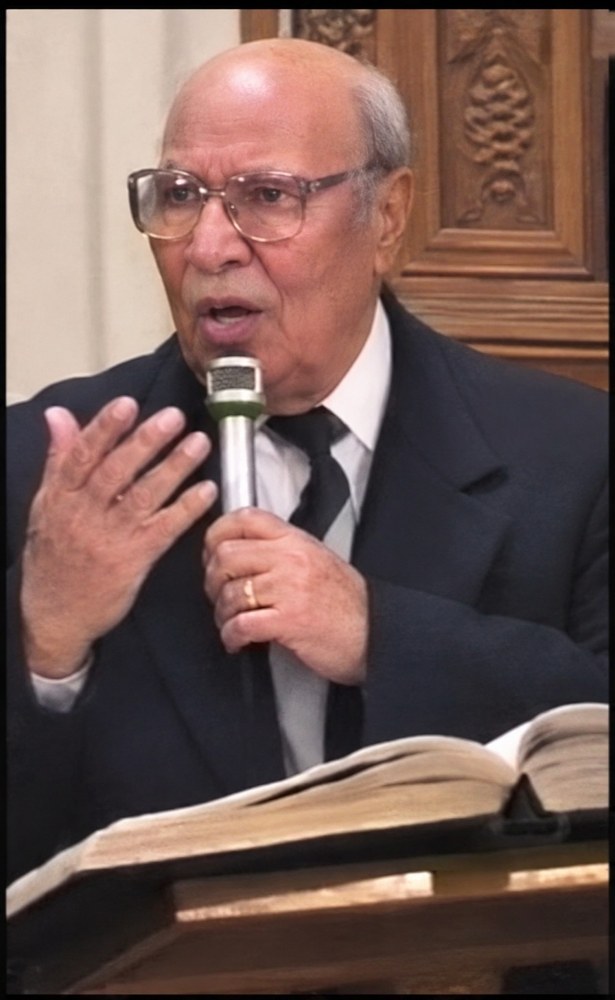
He learned from Mikhail al-Batanuni. Carolyn Ramzy names him among Mikhail’s pupils,5 and Laurence Moftah counts him in the second generation of cantors, “Farag Abdel-Messih (b. 1921-d. 2000).”6 The pupils did not all sing like their teacher: Ramzy writes that Farag “enjoyed a few ornaments, but certainly not as much as” Ṣadiq ʿAttallah.7
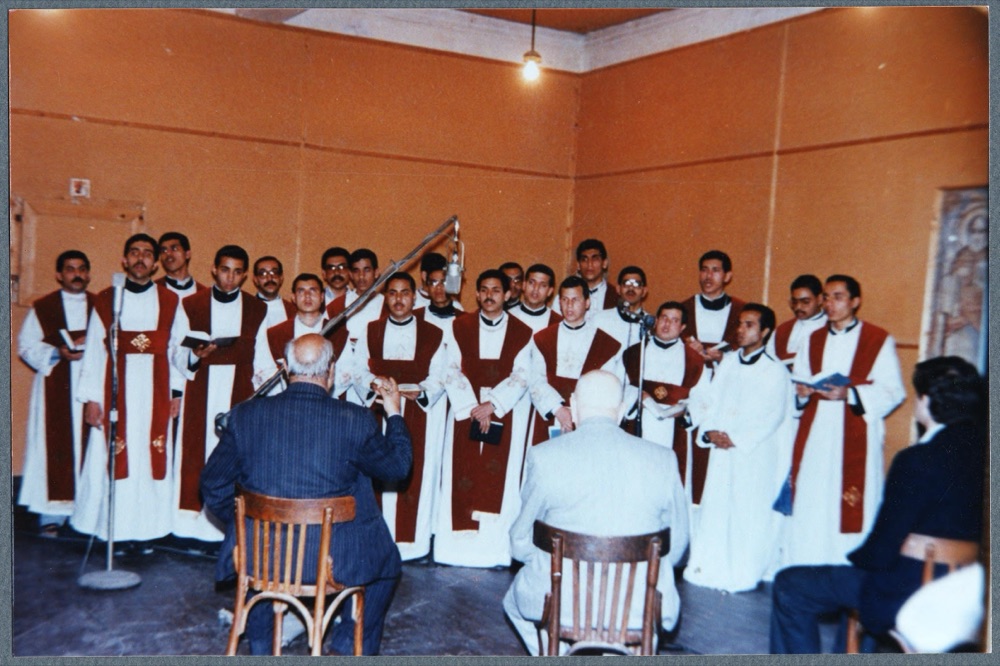
He taught at the Clerical College and the Didymus Institute. In 1989 al-Kirāza described him as “مدرس الألحان بالكلية الإكليريكية ومعهد ديديموس ومرتل كنيسة العذراء بروض الفرج” (teacher of the hymns at the Clerical College and the Didymus Institute, and cantor of the Church of the Virgin at Rawd al-Farag).8 In 1991 the Coptic Encyclopedia found the Didymus Institute for blind cantors in Shubra, “under the direction of Muʿallim Faraj.”9 When Pope Shenouda III met the teachers of the Clerical College on 31 July 1995, Farag was among them, teaching the liturgy and the hymns, with Ibrahim Ayad,10 and in 1998 the Didymus Institute reported that he had come back to teach after visiting his children in Australia.11
He taught Moftah’s choir. Pope Shenouda III, at Ragheb Moftah’s funeral, named him among the teachers of the choir: “Muʿallim Farag ʿAbd al-Masih, teacher of the hymns at the Clerical College.”12
His books and praises
He edited books for deacons and wrote praises. He compiled and arranged al-Durra al-Urthūdhuksiyya, a collection of the Church’s praises and hymns,13 and an edition of The Service of the Deacon, sold at his church.14 He composed praises (madāʾiḥ) of his own, among them praises for the distribution at the feast of Nayruz and on ordinary days, and for St. Mark, St. Theodore the Eastern and St. Macarius the Great.15
His repose
He reposed on the day the patriarch called him. On Tuesday 11 April 2000 Pope Shenouda III received Ragheb Moftah to talk about unifying the hymns through a committee of three cantors: Muʿallim Farag of the Clerical College, Muʿallim Nagi of Alexandria and Muʿallim Tawfiq of Dayr al-Muharraq. That evening, al-Kirāza reported, Farag reposed.16 His funeral was held at the Church of the Virgin at Rawd al-Farag, where the patriarch sent his secretary, Bishop Yoannes, to lead the prayers, after “decades of service handing on the hymns and the liturgy.”17
His recordings are still taught. In 2014 the hymns department of the Institute of Coptic Studies taught its courses from the recordings of Muʿallim Mikhail al-Batanuni and Muʿallim Farag ʿAbd al-Masih.18 On this site you can hear his recordings.
Photographs
Notes
- Ramzy, “A Musical Inheritance”, para. 5. ↩
- al-Kirāza 1989, notice, p. 10. ↩
- Shenouda III, al-Kirāza 2001, p. 10. ↩
- al-Kirāza 2000, p. 5, tr. ours. ↩
- Ramzy, “A Musical Inheritance”, para. 5. ↩
- L. Moftah, “Scholars of Music”, para. 34. ↩
- Ramzy 2015, p. 78. ↩
- al-Kirāza 1989, notice, p. 10, tr. ours. ↩
- Moftah, Robertson, Roy and Tóth, “Music, Coptic”, vol. 6, “Cantors, Their Role and Musical Training”. ↩
- al-Kirāza 1995, “al-Bābā maʿa hayʾat al-tadrīs”, p. 4. ↩
- al-Kirāza 1998, Didymus Institute, p. 11. ↩
- Shenouda III, al-Kirāza 2001, p. 10, tr. ours. ↩
- al-Kirāza 1989, notice, p. 10. ↩
- al-Kirāza 1991, notice, p. 20. ↩
- Hymns Guide, Farag ʿAbd al-Masih, “His works”. ↩
- al-Kirāza 2000, p. 4. ↩
- al-Kirāza 2000, p. 5, tr. ours. ↩
- al-Kirāza 2014, notice, p. 5. ↩
Sources
- Carolyn M. Ramzy, “A Musical Inheritance: Coptic Cantors and an Orally Transmitted Tradition,” Library of Congress, cited by paragraph.
- “Ṣadara ḥadīthan,” notice of al-Durra al-Urthūdhuksiyya, al-Kirāza 17, no. 15, Cairo, 14 April 1989, p. 10.
«صدر حديثاً: كتاب الدرة الأرثوذكسية»، الكرازة، السنة ١٧، العدد ١٥، ١٤ أبريل ١٩٨٩ - Pope Shenouda III, address at the funeral of Ragheb Moftah, al-Kirāza 29, nos. 21-22, Cairo, 29 June 2001, pp. 9-10.
البابا شنوده الثالث، «كلمة قداسة البابا في جناز الأستاذ راغب مفتاح»، الكرازة، السنة ٢٩، العددان ٢١-٢٢، ٢٩ يونيو ٢٠٠١ - News of the Church and notice of the repose of Muʿallim Farag, al-Kirāza 28, nos. 15-16, Cairo, 21 April 2000, pp. 4-5.
أخبار الكنيسة و«نياحة أرخن فاضل»، الكرازة، السنة ٢٨، العددان ١٥-١٦، ٢١ أبريل ٢٠٠٠ - Laurence Moftah, “Ragheb Moftah, Scholars of Music, Sound Engineer, Audio Recording Collection, and the Recording Equipment,” Library of Congress, 2006, cited by paragraph.
- Carolyn M. Ramzy, “Modern Singing Sons of the Pharaohs: Transcriptions and Orientalism in a Digital Coptic Music Collection,” Ethnologies 37, no. 1, 2015, pp. 65-88.
- Ragheb Moftah, Marian Robertson, Martha Roy and Margit Tóth, “Music, Coptic,” in The Coptic Encyclopedia, ed. Aziz S. Atiya, New York, 1991, vol. 6, pp. 1715-1747, cited by its sections.
- “al-Bābā maʿa hayʾat al-tadrīs bi-l-Kulliyya al-Iklīrīkiyya bi-l-Qāhira,” al-Kirāza 23, nos. 31-32, Cairo, 11 August 1995, p. 4.
«البابا مع هيئة التدريس بالكلية الإكليريكية بالقاهرة»، الكرازة، السنة ٢٣، العددان ٣١-٣٢، ١١ أغسطس ١٩٩٥ - Report of the Didymus Institute for cantors, al-Kirāza 26, nos. 43-44, Cairo, 13 November 1998, p. 11.
«معهد ديديموس للمرتلين (العرفاء)»، الكرازة، السنة ٢٦، العددان ٤٣-٤٤، ١٣ نوفمبر ١٩٩٨ - Notice of Khidmat al-shammās, al-Kirāza 19, nos. 1-2, Cairo, 4 January 1991, p. 20.
«صدر كتاب خدمة الشماس»، الكرازة، السنة ١٩، العددان ١-٢، ٤ يناير ١٩٩١ - “al-Muʿallim Faraj ʿAbd al-Masīḥ,” Dalīl al-alḥān al-qibṭiyya (Coptic Hymns Guide), 2012.
«المعلم فرج عبد المسيح»، دليل الألحان القبطية - Notice of the 27th course of the hymns department, Institute of Coptic Studies, al-Kirāza 42, nos. 5-6, Cairo, 31 January 2014, p. 5.
إعلان الدورة التعليمية السابعة والعشرين لقسم الألحان، الكرازة، السنة ٤٢، العددان ٥-٦، ٣١ يناير ٢٠١٤